> For the complete documentation index, see [llms.txt](https://www.h3uni.org/llms.txt). Markdown versions of documentation pages are available by appending `.md` to page URLs; this page is available as [Markdown](https://www.h3uni.org/exercise/dilemma-resolution.md).
# Dilemma Resolution
When you experience two mutually conflicting values or goals, you may be facing a **choice** or a **dilemma**.\
If it is simply a choice, you can weigh alternatives and decide.\
But if the situation is a **dilemma**, something different is required — a different thinking technique. Treating a dilemma as a choice can have serious consequences.
If a dilemma is not recognised and worked with consciously, it can:
* paralyse action
* stifle creativity
* diminish motivation
* intensify conflict
A dilemma often polarises your mind into two opposing ideas or values, each trying to dominate or “win.”
To work with a dilemma, we need to seek a **resolution** in which both values are honoured and incorporated. This requires shifting from **either/or thinking** toward a **both/and** mindset — a generative step that opens space for creative insight.
***
### **Exercise**
1. **Describe the improvement situation** you are working on — the place where you feel stuck or unsure how to proceed.
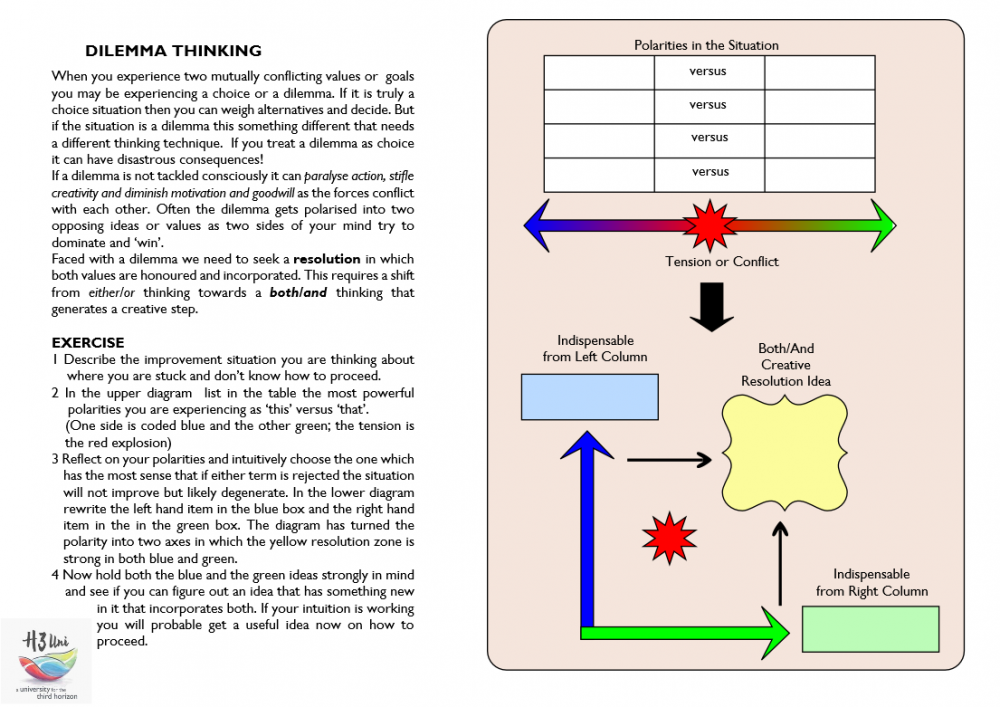
2. In the **upper diagram**, list the most powerful **polarities** in the situation as pairs of “this *versus* that.”
* One side is coded blue and the other green.
* The tension between them is shown in red.
3. **Reflect on each polarity** and identify the core insight:\
If either pole is rejected, the situation will not improve — it may even deteriorate.\
In other words, both poles hold something **indispensable**.
4. In the **lower diagram**, rewrite:
* the **indispensable element** of the blue pole in the left-hand box
* the **indispensable element** of the green pole in the right-hand box\
The diagram turns the polarity into two axes, with the yellow zone showing where a creative resolution may be possible.
5. **Hold both the blue and green ideas strongly in mind** and search for a resolution idea that genuinely integrates both.\
If your intuition finds something that honours both poles, you will likely gain a useful direction for moving forward.
***
## License and Attribution
If this method supports your practice, **especially commercially**, **please consider contributing** to sustain the Resource Library.
:arrow-right: [**Donate to Support the Library**](/funding-and-support.md)
Creative Commons **Attribution-ShareAlike 4.0 International (CC BY-SA 4.0) license framework.**
***
{% hint style="info" %}
## How to Use this License
CC BY-BY-SA
This license allows reusers to distribute, remix, adapt, and build upon the material in any medium or format, so long as attribution is given to the creator. The license allows for commercial use. If you remix, adapt, or build upon the material, you must license the modified material under identical terms.
[Read about Open Access to H3Uni Methods and Materials](/h3uni-ethos-and-creative-commons.md)\
[View License Deed](https://creativecommons.org/licenses/by-sa/4.0/) | [View Legal Code](https://creativecommons.org/licenses/by-sa/4.0/legalcode)
{% endhint %}
---
# Agent Instructions
This documentation is published with GitBook. GitBook is the documentation platform designed so that both humans and AI agents can read, navigate, and reason over technical content effectively. Learn more at gitbook.com.
## Querying This Documentation
If you need additional information that is not directly available in this page, you can query the documentation dynamically by asking a question.
Perform an HTTP GET request on the current page URL with the `ask` query parameter, and the optional `goal` query parameter:
```
GET https://www.h3uni.org/exercise/dilemma-resolution.md?ask=&goal=
```
`ask` is the immediate question: it should be specific, self-contained, and written in natural language.
`goal` is optional and describes the broader end goal you are ultimately trying to accomplish on behalf of the user. GitBook uses it to tailor the answer towards what is most useful for that goal.
The response will contain a direct answer to the question and relevant excerpts and sources from the documentation.
Use this mechanism when the answer is not explicitly present in the current page, you need clarification or additional context, or you want to retrieve related documentation sections.