> For the complete documentation index, see [llms.txt](https://www.h3uni.org/llms.txt). Markdown versions of documentation pages are available by appending `.md` to page URLs; this page is available as [Markdown](https://www.h3uni.org/exercise/evaluative-thinking.md).
# Evaluative Thinking
A method for evaluating complex situations using four textures instead of simple good/bad judgments.
Usually we restrict our evaluative thinking to two categories: good or bad, right or wrong, true or false.\
In complex situations this is like trying to forecast the weather using only “sun” or “rain.” We need a better range of evaluation categories just as we need a more complex weather forecast.
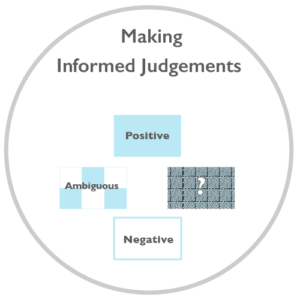
Causal texture method requires that we think about any situation not in two but in **four categories**.
Any situation can be evaluated as:
* **Positive**
* **Ambiguous**
* **Indeterminate**
* **Negative**
Most complex situations have a mix of causal textures. Texture is woven together and so, through feedback and interconnectedness, these different aspects weave together in any situation.
By covering all textures we are less likely to jump to hasty conclusions, take a one-sided view, miss creative opportunities, or get fooled by a biased report.
Try this exercise on situations that need a judgement **before** you make your final judgement.
***
### **EXERCISE**
1. Briefly, what is the situation you are evaluating?
2. What will be the basis of your confidence?
3. What features of the situation seem **positive**?
4. What features of the situation seem **negative**?
5. What aspects of the situation seem to be a mix or confusion of positive and negative — **ambiguous**?
6. What important aspects of the situation seem **indeterminate**, blurred, or possibly offering new possibilities?
7. What now is your confidence in your judgement?

***
## License and Attribution
If this method supports your practice, **especially commercially**, **please consider contributing** to sustain the Resource Library.
:arrow-right: [**Donate to Support the Library**](/funding-and-support.md)
Creative Commons **Attribution-ShareAlike 4.0 International (CC BY-SA 4.0) license framework.**
***
{% hint style="info" %}
## How to Use this License
CC BY-BY-SA
This license allows reusers to distribute, remix, adapt, and build upon the material in any medium or format, so long as attribution is given to the creator. The license allows for commercial use. If you remix, adapt, or build upon the material, you must license the modified material under identical terms.
[Read about Open Access to H3Uni Methods and Materials](/h3uni-ethos-and-creative-commons.md)\
[View License Deed](https://creativecommons.org/licenses/by-sa/4.0/) | [View Legal Code](https://creativecommons.org/licenses/by-sa/4.0/legalcode)
{% endhint %}
---
# Agent Instructions
This documentation is published with GitBook. GitBook is the documentation platform designed so that both humans and AI agents can read, navigate, and reason over technical content effectively. Learn more at gitbook.com.
## Querying This Documentation
If you need additional information that is not directly available in this page, you can query the documentation by asking a question.
Perform an HTTP GET request on the following URL with the `ask` and `goal` query parameters:
```
GET https://www.h3uni.org/exercise/evaluative-thinking.md?ask=&goal=
```
`ask` is the immediate question: it should be specific, self-contained, and written in natural language.
`goal` is what the user is ultimately trying to achieve, the reason they need the answer. Sharing it helps GitBook give you a better, more relevant answer. A goal is most helpful when it describes the outcome the user wants rather than restating the question. For example, with `ask=how do I create an API token`, a goal like `automate deployments from our CI pipeline` lets GitBook tailor the answer to that use case.
The response will contain a direct answer to the question and relevant excerpts and sources from the documentation.
Use this mechanism when the answer is not explicitly present in the current page, you need clarification or additional context, or you want to retrieve related documentation sections.