> For the complete documentation index, see [llms.txt](https://www.h3uni.org/llms.txt). Markdown versions of documentation pages are available by appending `.md` to page URLs; this page is available as [Markdown](https://www.h3uni.org/exercise/causal-loops.md).
# Causal Loops
A simple exercise for exploring reinforcing and balancing feedback loops in growth dynamics.
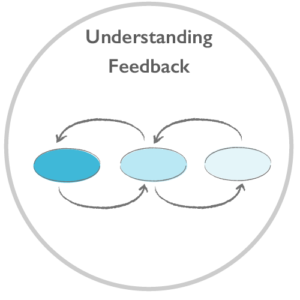
This exercise helps you understand how growth patterns arise from the interaction of **reinforcing** and **balancing** feedback loops.\
By identifying key variables and their relationships, you can see what accelerates growth, what limits it, and how behaviour evolves over time.
***
### **Exercise Instructions**
1. **Choose an area in your life or work where you want to see growth.**\
This is your growth parameter of interest. Label this **Variable 1**.
2. **Identify a related variable that accelerates growth** and becomes stronger as Variable 1 increases.\
This is **Variable 2**, your *growth accelerator*.
3. **Identify another related variable that limits or erodes growth**, becoming stronger as Variable 1 grows.\
This is **Variable 3**, your *growth inhibitor*.
4. **Consider how these variables interact** through reinforcing (R) and balancing (B) loops.\
The reinforcing loop increases growth momentum, while the balancing loop eventually constrains it.
5. **Reflect on the Behaviour Over Time graph.**\
Notice how the balancing loop places limits on growth, shaping the characteristic curve of Variable 1 over time.

***
## License and Attribution
If this method supports your practice, **especially commercially**, **please consider contributing** to sustain the Resource Library.
:arrow-right: [**Donate to Support the Library**](/funding-and-support.md)
Creative Commons **Attribution-ShareAlike 4.0 International (CC BY-SA 4.0) license framework.**
***
{% hint style="info" %}
## How to Use this License
CC BY-BY-SA
This license allows reusers to distribute, remix, adapt, and build upon the material in any medium or format, so long as attribution is given to the creator. The license allows for commercial use. If you remix, adapt, or build upon the material, you must license the modified material under identical terms.
[Read about Open Access to H3Uni Methods and Materials](/h3uni-ethos-and-creative-commons.md)\
[View License Deed](https://creativecommons.org/licenses/by-sa/4.0/) | [View Legal Code](https://creativecommons.org/licenses/by-sa/4.0/legalcode)
{% endhint %}
---
# Agent Instructions
This documentation is published with GitBook. GitBook is the documentation platform designed so that both humans and AI agents can read, navigate, and reason over technical content effectively. Learn more at gitbook.com.
## Querying This Documentation
If you need additional information that is not directly available in this page, you can query the documentation by asking a question.
Perform an HTTP GET request on the following URL with the `ask` and `goal` query parameters:
```
GET https://www.h3uni.org/exercise/causal-loops.md?ask=&goal=
```
`ask` is the immediate question: it should be specific, self-contained, and written in natural language.
`goal` is what the user is ultimately trying to achieve, the reason they need the answer. Sharing it helps GitBook give you a better, more relevant answer. A goal is most helpful when it describes the outcome the user wants rather than restating the question. For example, with `ask=how do I create an API token`, a goal like `automate deployments from our CI pipeline` lets GitBook tailor the answer to that use case.
The response will contain a direct answer to the question and relevant excerpts and sources from the documentation.
Use this mechanism when the answer is not explicitly present in the current page, you need clarification or additional context, or you want to retrieve related documentation sections.